
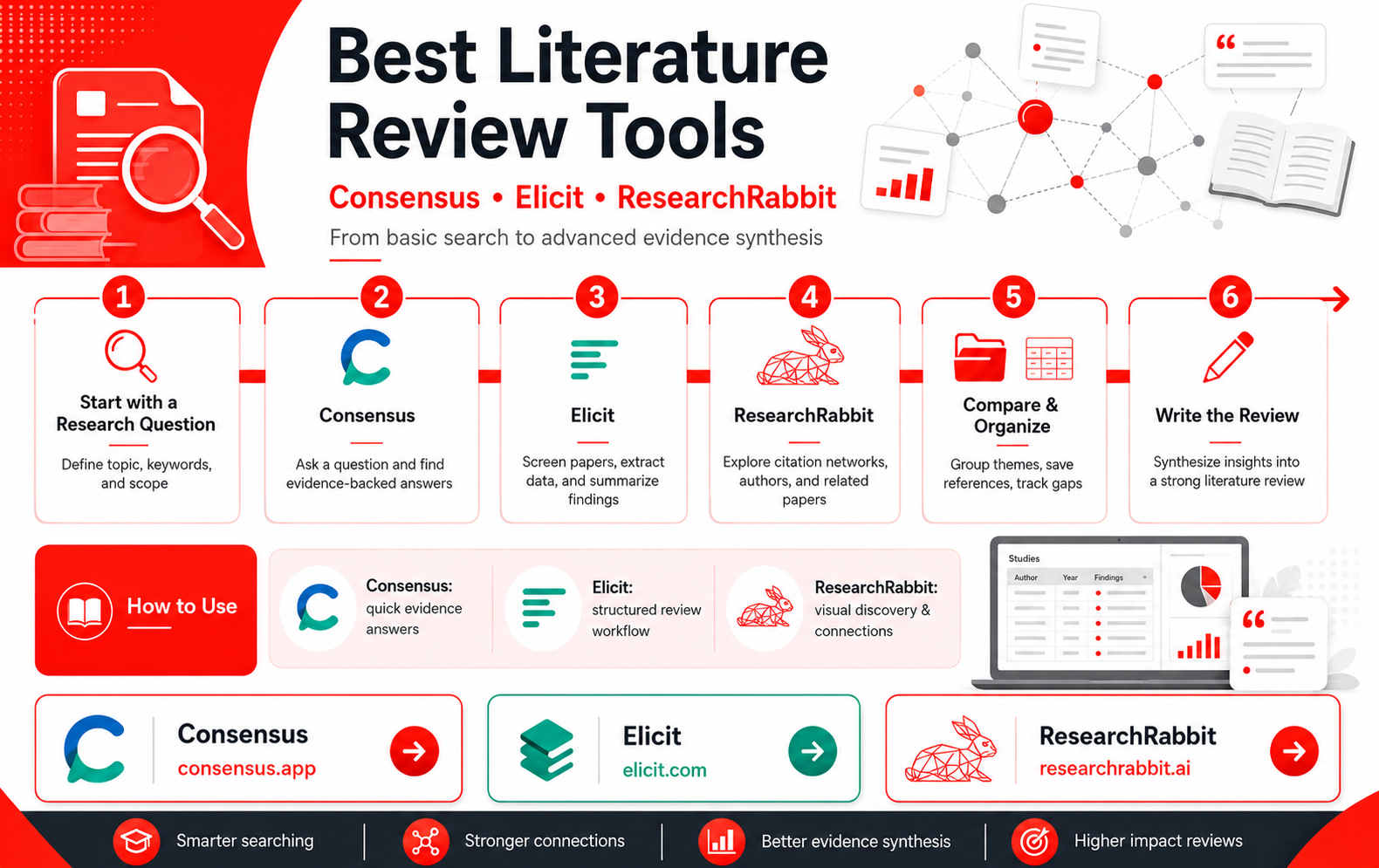
Best Literature Review Tools
Learn a practical workflow using Consensus, Elicit and ResearchRabbit—from defining a research question to discovering papers, screening evidence, mapping citations, organizing themes and writing a transparent literature review.
Complete Workflow
🔎Step 1 — Define a Focused Research QuestionStart with a clear topic, population or system, concept, outcome and review boundary.
PICO / PECO
Keywords
Inclusion criteria
Time range⌄
How to begin
- Write the topic in one sentence.
- Define what evidence is relevant and what should be excluded.
- List synonyms, abbreviations and alternative spellings.
- Decide whether your review is exploratory, narrative, scoping or systematic.
CStep 2 — Use Consensus for a Rapid Evidence OverviewAsk a natural-language research question and inspect the linked papers behind the answer.
Question search
Evidence overview
Filters
Source checking⌄
Practical use
- Enter the research question in plain language.
- Review the answer summary, but do not stop there.
- Open the cited papers and check study design, sample, outcome and publication year.
- Refine the question and apply available filters to narrow the evidence.
- Record useful seed papers for Elicit and ResearchRabbit.
Best for: a quick orientation to a topic, checking whether evidence appears supportive, mixed or limited, and finding initial papers.
Open Consensus ↗≡Step 3 — Use Elicit for Screening and Data ExtractionSearch semantically, compare papers in a table and extract structured study information.
Semantic search
Screening
Extraction columns
Research reports⌄
Practical use
- Enter the same focused question used in Step 2.
- Inspect title, abstract, year, citation information and relevance.
- Create useful columns such as population, sample size, intervention, control, outcome, method and limitation.
- Screen papers against your inclusion and exclusion criteria.
- Export or record the final study list and extracted evidence.
Best for: turning an unstructured paper list into a transparent evidence table that is easier to compare.
Open Elicit ↗🐇Step 4 — Use ResearchRabbit for Citation DiscoveryStart from strong seed papers and explore connected articles, authors and publication clusters.
Seed papers
Citation network
Related work
Author maps⌄
Practical use
- Create a collection for the review topic.
- Add 3–10 highly relevant seed papers from Consensus or Elicit.
- Explore earlier work, later citing papers, similar papers and key authors.
- Use the visual map to identify clusters, influential articles and missing subtopics.
- Add relevant discoveries to the collection and rescreen them using your criteria.
Best for: expanding beyond keyword search and understanding how papers, authors and themes connect.
Open ResearchRabbit ↗🗂️Step 5 — Compare, Organize and Identify Research GapsMerge the evidence into themes, compare study quality and document disagreements.
Evidence matrix
Themes
Contradictions
Research gaps⌄
Build an evidence matrix
Create one row per study and columns for citation, study design, population, exposure/intervention, comparator, outcome, key result, limitation and quality note.
Group the evidence
- Organize papers by method, population, mechanism, outcome or chronology.
- Separate consistent evidence from mixed or contradictory findings.
- Record missing populations, short follow-up, small samples or methodological weaknesses.
- Do not treat citation count as a substitute for methodological quality.
✍️Step 6 — Write, Cite and Verify the Literature ReviewMove from paper-by-paper summaries to a thematic, critical and properly cited synthesis.
Synthesis
Critical appraisal
Citation verification
Limitations⌄
Recommended writing structure
- Introduction: define the topic, importance and review objective.
- Search approach: briefly state databases/tools, keywords and screening criteria.
- Thematic synthesis: compare evidence across themes rather than summarizing one paper at a time.
- Critical appraisal: discuss strength, bias, inconsistency and generalizability.
- Research gaps: explain what remains unknown.
- Conclusion: provide a balanced answer to the research question.
Which Tool Should You Use?
| Task | Consensus | Elicit | ResearchRabbit |
|---|---|---|---|
| Best starting point | Ask a direct research question | Run a structured paper search | Add strong seed papers |
| Main strength | Rapid evidence-linked orientation | Screening, comparison and extraction | Visual citation and author discovery |
| Best output | Initial answer and source list | Evidence table or research report | Paper collection and network map |
| Use with caution | Summary may hide study differences | Extraction still requires verification | Network relevance is not quality appraisal |
Responsible AI Use
Use AI to accelerate the workflow—not to replace scholarly judgment.
Always verify claims against the original paper, document your search and screening process, report limitations, and follow your university or journal policies on AI-assisted research. For a formal systematic review, also use appropriate bibliographic databases and a predefined protocol.