
AMRA-LAB · MANUSCRIPT QUALITY GUIDE
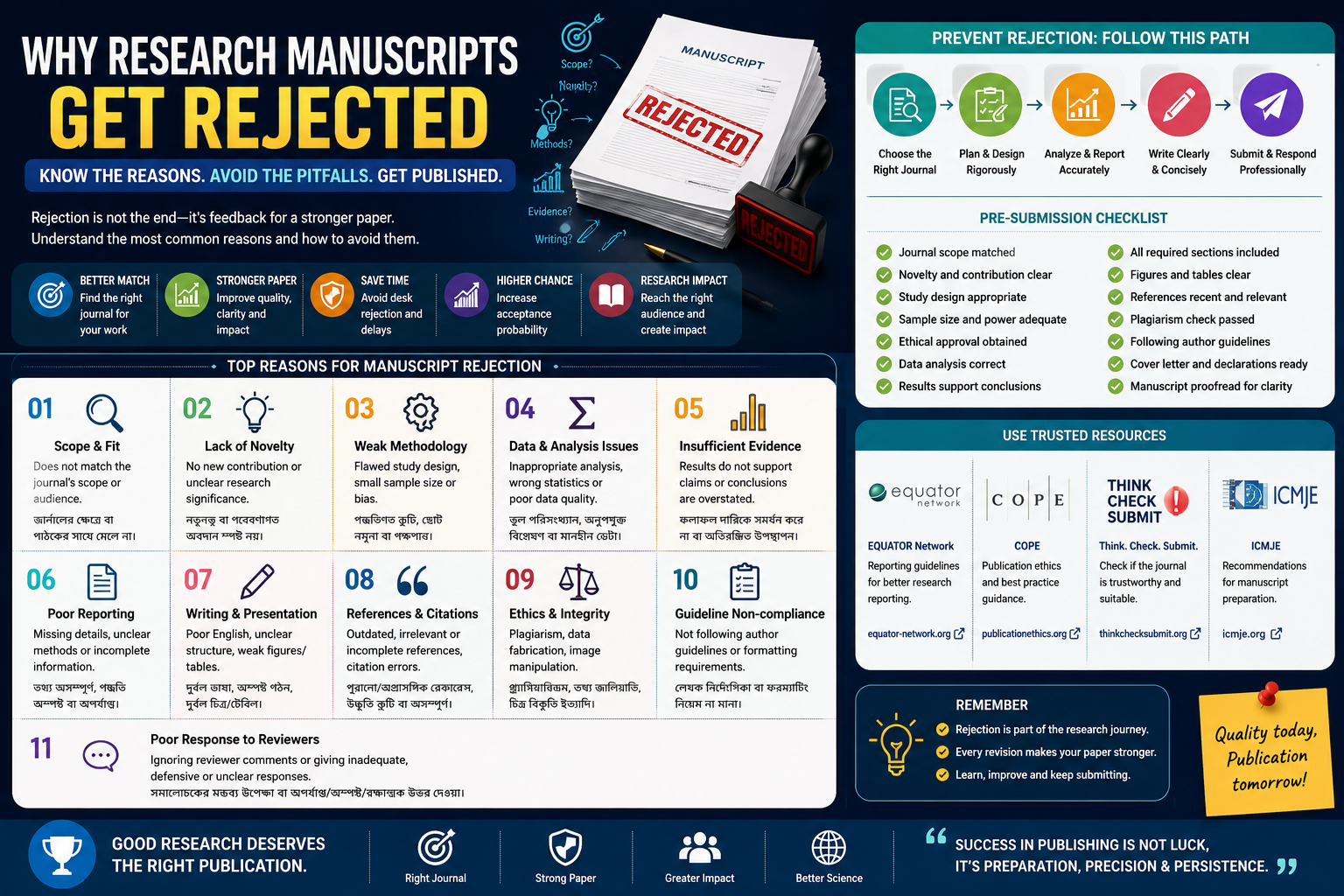
Why Research Manuscripts Get Rejected
A clear, bilingual guide to the most common causes of desk rejection and peer-review rejection—plus a practical prevention workflow for improving scientific fit, rigor, transparency and presentation before submission.
Desk Rejection
Peer Review
Scientific Rigor
Reporting Quality
Publication Ethics
🎯
Journal Fit FailureWrong scope, audience, article type or editorial priority.🧪
Scientific WeaknessLimited novelty, flawed design, insufficient data or weak analysis.⚠️
Reporting & Ethics ProblemsMissing details, authorship issues, plagiarism or undisclosed conflicts.✍️
Communication FailureUnclear writing, poor figures, overclaiming or disorganized presentation.EQ
EQUATOR Reporting Guidelines
Find structured reporting checklists for different study designs.
COPE
COPE Guidance
Review publication-ethics guidance on authorship, misconduct and editorial practice.
TCS
Think. Check. Submit.
Assess whether a journal or publisher is a trustworthy and suitable venue.
IC
ICMJE Recommendations
Review recognized guidance on manuscript preparation, authorship and disclosure.
Prevention Pathway: From Draft to Submission
1🎯
Confirm Journal FitScope · audience · article type
2💡
Strengthen NoveltyGap · contribution · significance
3🧪
Audit Methods & DataDesign · controls · statistics
4📋
Improve ReportingChecklist · transparency · ethics
5🖋️
Refine PresentationWriting · figures · structure
6✅
Run Final ReviewInternal review · checklist · cover letter
EN
Major Causes of Manuscript Rejection
Rejection is rarely caused by one issue alone. A manuscript may have a useful idea but still fail because the journal is wrong, the study is underpowered, the claims exceed the data, or the writing prevents editors from seeing the true value of the work.
বাংলায়: Research paper rejection সাধারণত একক কারণে হয় না। Journal mismatch, weak methodology, insufficient evidence, poor reporting ও unclear writing একসঙ্গে সমস্যা তৈরি করতে পারে।
1Mismatch with Journal Scope or Editorial PriorityA technically sound manuscript can be rejected immediately when it does not fit the journal's audience or current priorities.Desk rejectionAims & scopeRecent papersArticle type⌄
Mismatch with Journal Scope or Editorial Priority
A technically sound manuscript can be rejected immediately when it does not fit the journal's audience or current priorities.
Desk rejectionAims & scopeRecent papersArticle type
- The topic is outside the journal's defined scope.
- The paper uses a format the journal does not accept.
- The work is too local, narrow or technical for the journal's readership.
- The question fits the field but not the journal's current editorial direction.
- The manuscript was selected mainly because of Impact Factor rather than true scope alignment.
Prevention: Read the Aims and Scope and at least 10 recent papers before submission.
বাংলায়: Journal-এর scope, audience বা article type-এর সঙ্গে paper না মিললে editor review ছাড়াই reject করতে পারেন।
2Weak Novelty or Unclear Scientific ContributionEditors need a precise answer to one question: what does this study add that is genuinely new and useful?NoveltyResearch gapContributionSignificance⌄
Weak Novelty or Unclear Scientific Contribution
Editors need a precise answer to one question: what does this study add that is genuinely new and useful?
NoveltyResearch gapContributionSignificance
- The study repeats known work without a meaningful extension.
- The research gap is vague or created artificially.
- The manuscript reports a small technical variation but claims a major breakthrough.
- The introduction does not connect the gap, objective and contribution.
- The paper's practical or theoretical importance is not demonstrated.
Prevention: Express the novelty in one sentence, then support it with direct comparison to the closest prior studies.
বাংলায়: Paper নতুন কী জ্ঞান যোগ করছে তা স্পষ্ট না হলে novelty দুর্বল মনে হয়। শুধু ছোট পরিবর্তনকে বড় breakthrough হিসেবে দেখাবেন না।
3Inadequate Study Design or Methodological RigorA strong conclusion cannot rescue a weak design.Study designControlsSample sizeValidation⌄
Inadequate Study Design or Methodological Rigor
A strong conclusion cannot rescue a weak design.
Study designControlsSample sizeValidation
- The design cannot answer the stated research question.
- Controls, comparison groups or validation experiments are missing.
- Sample size is too small or not justified.
- Important confounders are ignored.
- Methods are outdated, poorly selected or inconsistent.
- Computational results are not experimentally or independently validated when validation is essential.
Critical issue: Some design weaknesses cannot be repaired through rewriting after the study is complete.
বাংলায়: ভুল study design, inadequate control, ছোট sample বা validation না থাকলে paper-এর conclusion বিশ্বাসযোগ্য থাকে না।
4Statistical and Data-Analysis ProblemsIncorrect analysis can invalidate otherwise valuable data.StatisticsAssumptionsMultiple testingUncertainty⌄
Statistical and Data-Analysis Problems
Incorrect analysis can invalidate otherwise valuable data.
StatisticsAssumptionsMultiple testingUncertainty
- The statistical test does not match the data or design.
- Assumptions are not checked.
- Multiple comparisons increase false-positive risk without correction.
- Only p-values are reported without effect sizes or uncertainty.
- Data exclusions, outliers or missing values are handled without explanation.
- Figures and tables contradict the written results.
Prevention: Have the analysis reviewed before writing the final discussion, not after submission.
বাংলায়: Wrong statistical test, unreported assumptions, multiple testing বা unexplained data exclusion paper reject হওয়ার বড় কারণ।
5Insufficient Evidence or Overstated ConclusionsClaims must stay within the limits of the data and study design.OverclaimingCausalityGeneralizationLimitations⌄
Insufficient Evidence or Overstated Conclusions
Claims must stay within the limits of the data and study design.
OverclaimingCausalityGeneralizationLimitations
- Correlation is described as causation.
- Results from a small or specific sample are generalized too broadly.
- The abstract and title claim more than the methods support.
- Negative or conflicting findings are ignored.
- Study limitations are hidden or minimized.
- Mechanistic explanations are presented without direct evidence.
বাংলায়: Data যতটুকু support করে তার চেয়ে বেশি claim করলে reviewer আস্থা হারায়। Correlation-কে causation হিসেবে দেখাবেন না।
6Incomplete or Non-Transparent ReportingReaders must be able to understand, evaluate and, where appropriate, reproduce the work.Reporting guidelineReproducibilityData availabilityProtocol⌄
Incomplete or Non-Transparent Reporting
Readers must be able to understand, evaluate and, where appropriate, reproduce the work.
Reporting guidelineReproducibilityData availabilityProtocol
- Methods lack enough detail for evaluation or replication.
- Key eligibility criteria, model settings or experimental conditions are missing.
- Data, code or protocol availability is not stated where relevant.
- The manuscript ignores an appropriate reporting checklist.
- Outcome switching or selective reporting is suspected.
- Results are presented without explaining how they were generated.
Prevention: Choose the appropriate reporting guideline early and use it during writing, not only at submission.
বাংলায়: Method, parameter, eligibility criteria, code/data statement বা reporting checklist অসম্পূর্ণ হলে reproducibility কমে যায়।
7Poor Writing, Structure or Logical FlowEditors may reject when the scientific message is difficult to extract from the manuscript.ClarityStructureLanguageLogical flow⌄
Poor Writing, Structure or Logical Flow
Editors may reject when the scientific message is difficult to extract from the manuscript.
ClarityStructureLanguageLogical flow
- The introduction is long but does not define a focused question.
- The methods and results are not aligned with the stated objectives.
- Paragraphs contain multiple unrelated ideas.
- Technical language is used inaccurately or inconsistently.
- The discussion repeats results rather than interpreting them.
- Grammar and sentence structure obscure scientific meaning.
বাংলায়: Unclear writing, weak paragraph flow, inconsistent terminology ও disorganized structure paper-এর scientific value লুকিয়ে ফেলতে পারে।
8Weak Figures, Tables or Data VisualizationVisuals must communicate evidence, not decorate the manuscript.FiguresTablesResolutionCaptions⌄
Weak Figures, Tables or Data Visualization
Visuals must communicate evidence, not decorate the manuscript.
FiguresTablesResolutionCaptions
- Axes, units, legends or labels are missing.
- Image resolution is too low.
- Colors or symbols are inconsistent across figures.
- Tables duplicate information already shown in figures.
- Captions do not allow the visual to be understood independently.
- Image processing is excessive or insufficiently disclosed.
বাংলায়: Low-resolution figure, missing label, unclear caption বা duplicate table/figure reviewer-এর কাছে poor presentation হিসেবে ধরা পড়ে।
9Weak Literature Review or Inappropriate ReferencingThe manuscript must show awareness of relevant, current and competing evidence.Literature reviewCurrent sourcesBalanced citation⌄
Weak Literature Review or Inappropriate Referencing
The manuscript must show awareness of relevant, current and competing evidence.
Literature reviewCurrent sourcesBalanced citation
- Recent or directly relevant studies are omitted.
- References are used to decorate claims rather than support them.
- The review is biased toward one research group or viewpoint.
- Key contradictory evidence is ignored.
- Citations are incorrect, incomplete or mismatched with the reference list.
- Too many irrelevant references dilute the argument.
বাংলায়: গুরুত্বপূর্ণ recent paper, contradictory evidence বা relevant citation বাদ পড়লে manuscript outdated বা biased মনে হতে পারে।
10Publication-Ethics or Authorship ConcernsEthical uncertainty can lead to rejection, investigation or later retraction.PlagiarismAuthorshipConflict of interestDuplicate submission⌄
Publication-Ethics or Authorship Concerns
Ethical uncertainty can lead to rejection, investigation or later retraction.
PlagiarismAuthorshipConflict of interestDuplicate submission
- Text, figures or ideas are reused without proper attribution.
- The manuscript is submitted to more than one journal simultaneously.
- Authors are added or omitted without valid contribution.
- Conflicts of interest or funding are not disclosed.
- Ethics approval, consent or animal-welfare documentation is missing.
- Data fabrication, falsification or inappropriate image manipulation is suspected.
Serious consequence: Ethical problems can affect all authors and institutions, not only the corresponding author.
বাংলায়: Plagiarism, duplicate submission, improper authorship, undisclosed conflict বা ethics approval না থাকলে rejection ছাড়াও formal investigation হতে পারে।
11Failure to Follow Author GuidelinesCareless submission signals that the journal was not selected or prepared for seriously.FormattingWord limitFilesDeclarations⌄
Failure to Follow Author Guidelines
Careless submission signals that the journal was not selected or prepared for seriously.
FormattingWord limitFilesDeclarations
- Required sections or declarations are absent.
- Word, figure or reference limits are ignored.
- Files are uploaded in the wrong format.
- Blinding instructions are not followed.
- Supplementary materials are incomplete.
- The cover letter is generic or addressed to the wrong journal.
বাংলায়: Author guideline, word limit, file format, declaration বা blinded review rule না মানলে avoidable desk rejection হতে পারে।
12Inadequate Response to Reviewer CommentsA potentially publishable paper can still fail during revision if the response is incomplete or defensive.RevisionPoint-by-point responseEvidenceProfessional tone⌄
Inadequate Response to Reviewer Comments
A potentially publishable paper can still fail during revision if the response is incomplete or defensive.
RevisionPoint-by-point responseEvidenceProfessional tone
- Comments are answered selectively rather than point by point.
- The response says “done” without identifying the revised text.
- Reasonable requests are rejected without evidence.
- The tone is defensive or disrespectful.
- New analyses introduce contradictions that are not explained.
- The manuscript and response letter do not match.
Best practice: Quote each comment, explain the action taken, and identify the exact page and line of every change.
বাংলায়: Reviewer comment point-by-point উত্তর দিন, পরিবর্তন কোথায় করা হয়েছে তা page ও line numberসহ দেখান।
✓
Pre-Submission Quality Checklist
F
Journal fit confirmedScope, audience, article type and recent editorial priorities have been reviewed.N
Novelty is explicitThe closest prior work and the exact new contribution are stated clearly.M
Methods are defensibleDesign, controls, sample, validation and analysis can support the conclusions.R
Reporting is completeThe relevant guideline, ethics, data and disclosure statements are included.V
Visuals are publication-readyFigures, tables, labels, captions and files have been cross-checked.I
Independent review completedA colleague has reviewed logic, language, statistics and journal suitability.≋
Desk Rejection vs Peer-Review Rejection
| Stage | Typical reasons | What the editor or reviewer is assessing | Best prevention |
|---|---|---|---|
| Desk rejection | Scope mismatch, weak novelty, unsuitable article type, poor presentation, incomplete files | Whether the manuscript is worth external review | Target carefully and perform a strict editorial-readiness check |
| Peer-review rejection | Methodological flaws, insufficient evidence, statistical problems, overclaiming, incomplete reporting | Scientific validity, interpretation and contribution | Audit design, analysis, transparency and claims before submission |
| Rejection after revision | Major concerns remain unresolved, weak response letter, contradictory revisions | Whether the revised work has adequately addressed the evidence-based concerns | Respond point by point and revise the manuscript consistently |
!
Rejection does not automatically mean the research has no value
Some decisions reflect journal fit, limited reviewer confidence or editorial priorities rather than complete scientific failure. Read the decision carefully, separate fixable presentation issues from fundamental design limitations, revise honestly and retarget strategically.