
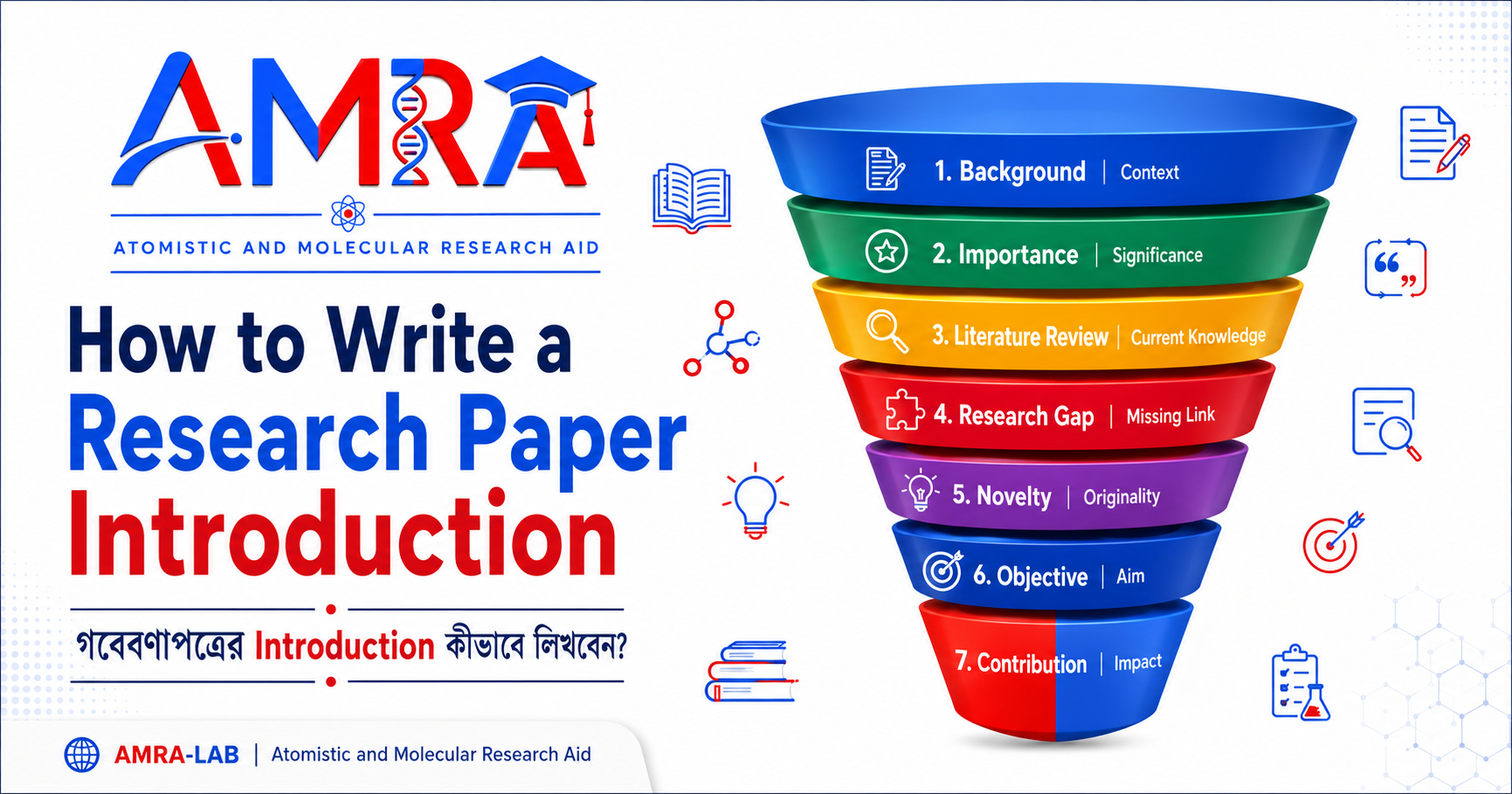
How to Write a Research Paper Introduction
A strong Introduction is a funnel-shaped scientific argument. It begins with a broad research landscape, narrows through existing evidence and missing knowledge, and finally reaches the exact purpose of your study.
The Introduction Works Like a Research Funnel
A strong research-paper Introduction begins with a broad scientific context and gradually narrows toward the exact purpose of the study. Each layer should logically prepare the reader for the next one.
The goal is not only to introduce the topic, but to prove that your research question is necessary, timely, and scientifically meaningful.
From broad research context to exact study objective
Click each cylindrical funnel layer to open the advanced explanation, writing logic, synonyms, and Bengali guidance.
1Background
Synonyms: Context | Research Landscape | Scientific Setting | Problem Area
The Background is the widest part of the Introduction. It gives the reader a broad view of the research area before moving into the specific problem. In biomedical or molecular research, this may include disease burden, prevalence, outbreak status, public-health importance, pathogen biology, or general scientific context.
- Start from the broad research area, not from your method.
- Explain what the topic is and why readers should pay attention.
- Use recent references to support disease prevalence, biological relevance, or global importance.
- Gradually narrow the discussion toward your specific system or target.
বাংলা ব্যাখ্যা
2Importance
Synonyms: Significance | Rationale | Relevance | Scientific Value
After presenting the broad context, explain why the topic matters. A strong Introduction does not simply say that the topic is important; it explains the scientific, clinical, technological, economic, environmental, or social reason behind that importance.
- Explain why the problem is urgent or scientifically meaningful.
- Show the practical or translational relevance of the topic.
- Connect the topic with human health, drug discovery, diagnostics, environment, agriculture, or technology.
- Support major claims with credible references.
বাংলা ব্যাখ্যা
3Literature Review
Synonyms: Previous Evidence | Current Knowledge | Prior Studies | State of the Art
The Literature Review inside the Introduction should be selective and analytical. It should not summarize every paper. It should present only the most relevant previous studies that prepare the reader for the Research Gap.
- Summarize key studies related to your topic, target, model, method, or dataset.
- Group previous work by concept, finding, method, or limitation.
- Show what is already known and accepted in the field.
- Avoid disconnected paper-by-paper listing.
বাংলা ব্যাখ্যা
4Research Gap
Synonyms: Knowledge Gap | Missing Link | Unresolved Question | Limitation
The Research Gap is the turning point of the Introduction. It explains what remains unknown, unclear, contradictory, insufficiently validated, or underexplored after previous studies.
- Identify the missing knowledge or unresolved mechanism.
- Explain the limitation of previous studies clearly.
- Show why further research is necessary.
- Connect the gap directly to your study design.
বাংলা ব্যাখ্যা
5Novelty
Synonyms: Originality | New Contribution | Innovation | Unique Aspect
Novelty explains what is new in your study compared with previous work. It can come from a new method, dataset, molecular system, compound library, simulation design, experimental condition, population, or interpretation.
- State what makes your study different from earlier studies.
- Explain the new method, dataset, model, target, or approach.
- Avoid exaggerated claims such as “first ever” unless fully verified.
- Make novelty specific and evidence-based.
বাংলা ব্যাখ্যা
6Objective
Synonyms: Aim | Purpose | Research Question | Hypothesis
The Objective is the narrowest part of the funnel. It tells the reader exactly what your study aims to do. The objective must directly answer the Research Gap and should be clear, measurable, and specific.
- State the main aim of the study clearly.
- Mention specific objectives when needed.
- Include research question or hypothesis if appropriate.
- Make sure the objective logically follows from the gap.
বাংলা ব্যাখ্যা
7Contribution
Synonyms: Impact | Value | Key Finding | Expected Insight
Many high-quality articles briefly indicate how the work contributes to the field. This does not mean writing the full result in the Introduction; rather, it shows the expected scientific value of the study.
- Explain how your study benefits the research field.
- Show whether it supports mechanism, prediction, drug design, validation, or future experiments.
- Indicate the broader value of the work without overclaiming.
- End the Introduction with confidence and clarity.
বাংলা ব্যাখ্যা
Example flow for biomedical or computational research
This is how the funnel may look in a real disease, virus, protein, docking, MD simulation, or drug-discovery article.
Example: Disease or Virus-Based Introduction
Background: Start with the disease, outbreak, public-health burden, prevalence, or treatment limitation.
Importance: Explain why the disease, virus, target, or pathway is important for health, therapy, or prevention.
Literature Review: Summarize key findings on the virus, protein structure, catalytic site, replication mechanism, or previous inhibitors.
Example: Gap to Your Work
Research Gap: Show what is still unclear, such as dynamic behavior, active-site flexibility, substrate recognition, or drug-binding stability.
Novelty: Explain what is new, such as longer MD simulation, new ligand set, new dataset, new environment, or integrated workflow.
Objective: End with a clear aim that directly addresses the gap and shows the expected scientific contribution.
What a strong Introduction must achieve
A strong Introduction does not only introduce the topic; it proves why the research must be done.
Start broad, build significance, synthesize previous studies, expose the missing knowledge, clarify novelty, state the objective, and show the expected contribution. That is how an Introduction becomes logical, persuasive, and journal-ready.