
PROJECT DESCRIPTION
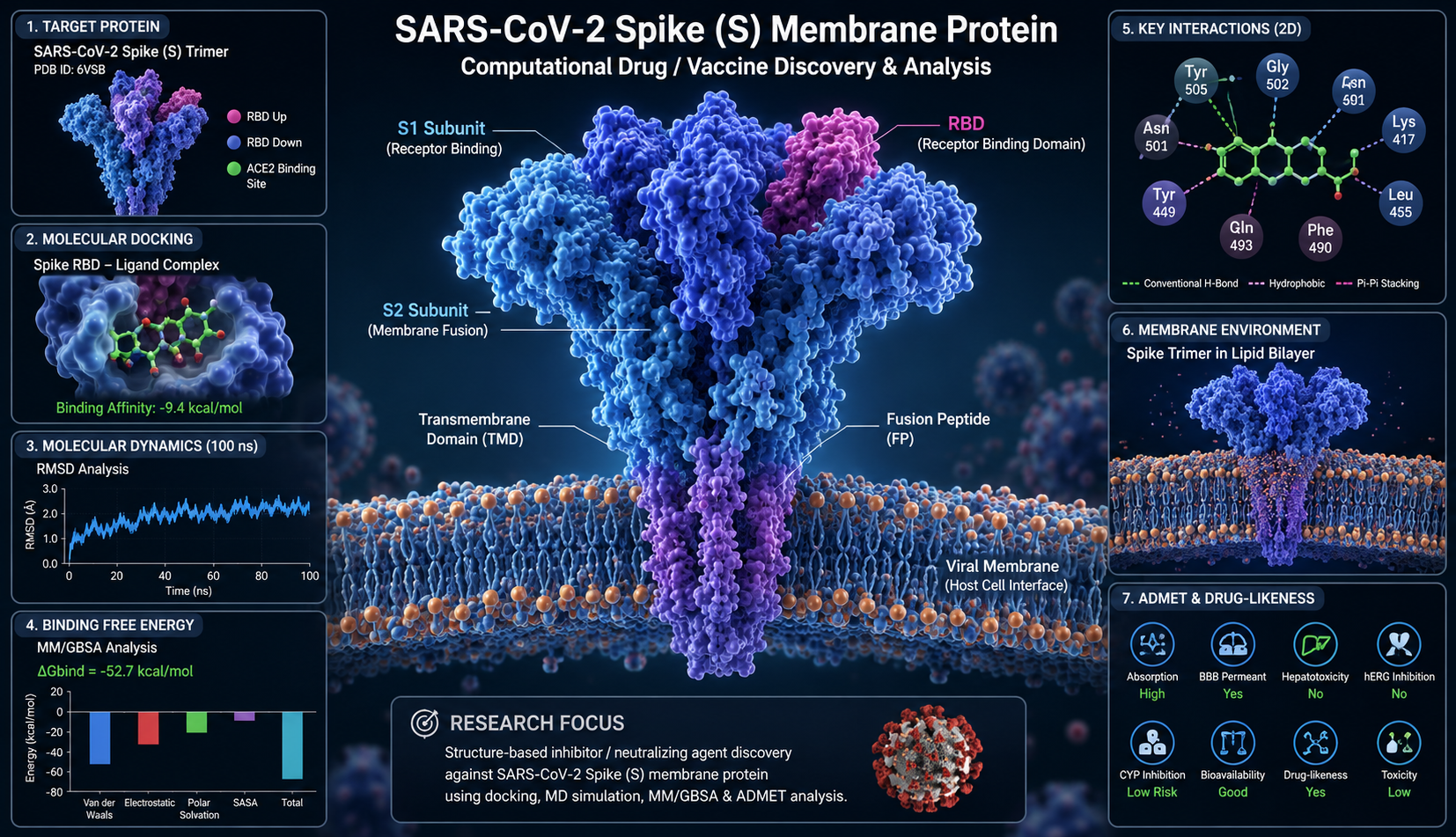
SARS-CoV-2 spike protein is a major viral membrane glycoprotein responsible for host-cell recognition, receptor binding, and membrane fusion. Because of its essential role in viral entry, the spike protein remains an important target for antiviral drug discovery, neutralizing agent design, vaccine-related structural analysis, and mutation-based binding studies.
This research project applies computational chemistry, molecular docking, membrane protein modeling, molecular dynamics simulation, and binding free energy analysis to investigate ligand or inhibitor interactions with the SARS-CoV-2 spike protein. Special focus is placed on the receptor-binding domain, S1/S2 functional regions, transmembrane environment, spike stability, ligand binding behavior, and ADMET-based lead selection.
PROJECT CONTENT
- SARS-CoV-2 spike protein structure preparation and refinement
- Spike trimer, receptor-binding domain, and membrane-associated region analysis
- Ligand preparation, geometry optimization, and drug-likeness filtering
- Molecular docking of antiviral candidates against spike protein binding regions
- 2D and 3D interaction analysis of hydrogen bonds, hydrophobic contacts, and π-interactions
- Membrane protein system setup using lipid bilayer environment
- Molecular dynamics simulation of spike–ligand or spike–membrane complexes
- RMSD, RMSF, Rg, SASA, hydrogen bond, and residue fluctuation analysis
- MM/GBSA or MM/PBSA binding free energy calculation
- ADMET, toxicity, bioavailability, and drug-likeness prediction
- Mutation-based binding stability and variant-focused interaction analysis
- Lead optimization based on docking score, MD stability, and pharmacokinetic profile