
PROJECT DESCRIPTION
Fungal toxins such as aflatoxin B1 are toxic secondary metabolites commonly produced by fungal species including Aspergillus flavus and Aspergillus parasiticus. These toxins may contaminate cereals, nuts, stored grains, and animal feed, causing serious health risks such as hepatotoxicity, carcinogenicity, immunotoxicity, and foodborne poisoning.
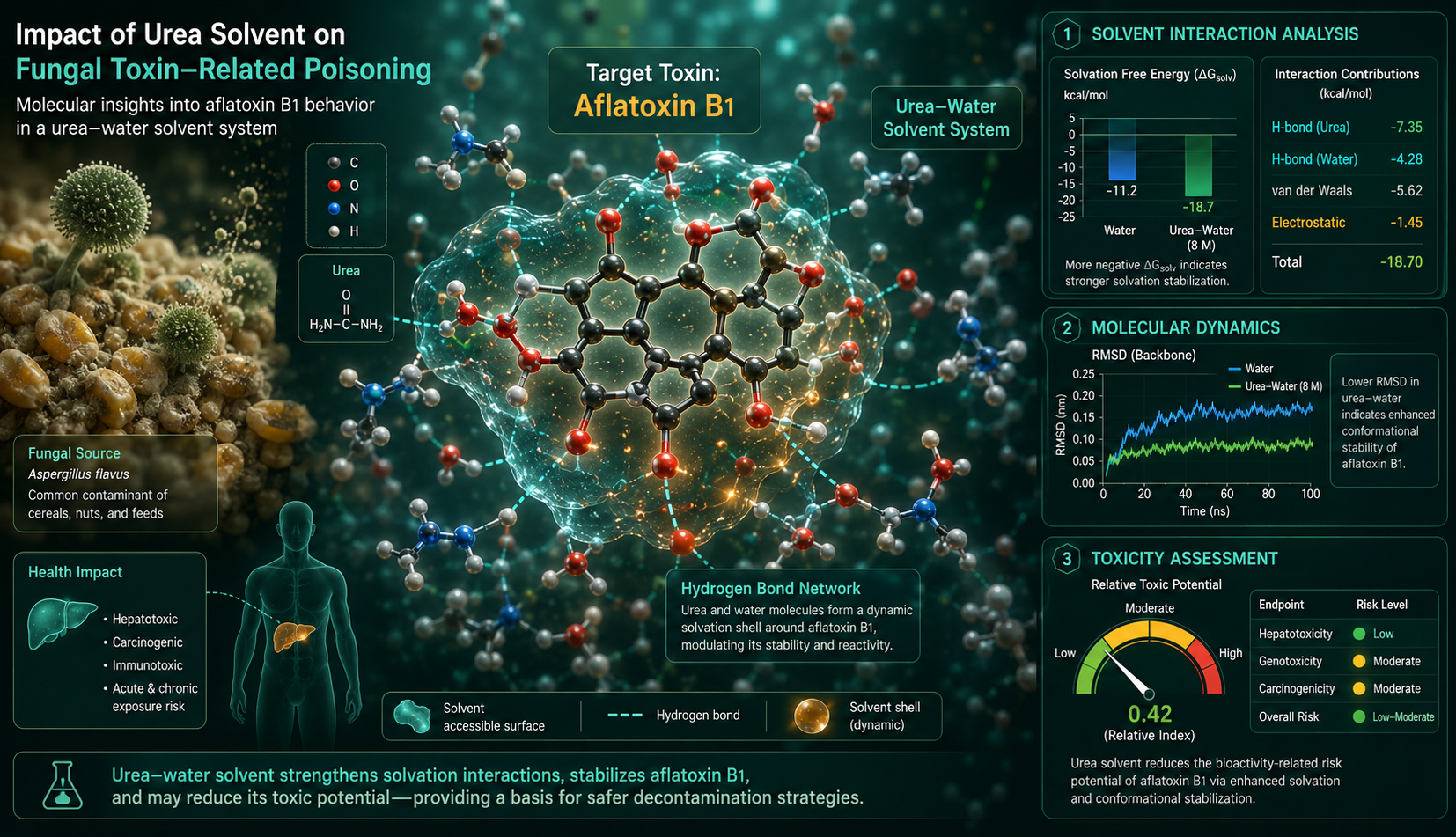
This research project investigates how urea–water solvent environments influence fungal toxin stability, solvation behavior, hydrogen bonding, molecular flexibility, and toxicity-related molecular properties. Molecular dynamics simulation and solvation analysis are used to understand whether urea-containing solvent systems can alter toxin conformation, interaction strength, and bioactivity-related risk.
PROJECT CONTENT
- Fungal toxin structure preparation and geometry optimization
- Aflatoxin B1 or related mycotoxin selection for solvent impact study
- Urea–water solvent box preparation at selected concentration
- Molecular dynamics simulation of toxin in water and urea–water systems
- Solvent-accessible surface area and solvation shell analysis
- Hydrogen bond network analysis between toxin, water, and urea molecules
- RMSD, radius of gyration, and conformational stability evaluation
- Solvation free energy and interaction contribution analysis
- Comparative water vs urea–water solvent behavior assessment
- Toxicity-related molecular descriptor evaluation
- Interpretation of solvent-induced changes in toxin stability and poisoning risk
- Application toward safer decontamination and toxin-interaction research